
Total ArmorHealth and Wellness

Ritual soaps

Pivot your
intention.

Sculpted soaps to bring a moment of intention to your daily cleansing ritual.

Ritual soaps

Sculpted in gold

Protect. Purify. Prevail.

Hover over a soap or select Bring to life. Open the product to explore the original sculpture from five angles.

Create your ritual pair

Two Egyptian soaps for $5.00. Choose two matching designs or mix Hathor, Pharaoh, Queen Nefertiti, and Anubis. Egyptian soaps are sold in pairs only.

USA shipping is $4.99 per order, with a maximum of eight individual items per order. Each Egyptian soap pair counts as two items. For more than eight items, place a separate order with its own $4.99 shipping charge. A 7% tax is added to the product subtotal. Orders are packed and mailed with care by Total Armor. We ship within the USA only. Local pickup will also be available.

The stories behind the forms

Contemporary soap designs with historical references. Open a history note to explore the figures and symbols through museum collections.

$5.00 per two-bar pair

Online checkout opens soon.

Discover Hathor’s history

Music, joy and motherhood

Hathor was associated with music and joy. Her image often appears on the sistrum, a ceremonial rattle, with a woman’s face and cow’s ears. The Met’s small plaque also connects her with motherhood.

Museum example: Plaque with Hathor Sistrum and Blessing to Bastet. New Kingdom, ca. 1550–1300 BCE.

Explore Hathor at The Met (new tab)
$5.00 per two-bar pair

Online checkout opens soon.

Explore royal imagery

The language of kingship

The striped nemes headdress and the uraeus cobra appear in Egyptian images of kingship. A limestone head in The Met’s collection shows how a Ptolemaic ruler used these established forms to connect himself with earlier pharaohs.

Museum example: Head of a King with a Nemes Headdress. Ptolemaic Period, 332–30 BCE.

Explore royal imagery at The Met (new tab)

$5.00 per two-bar pair

Online checkout opens soon.

Discover Nefertiti’s history

A queen of the Amarna period

Nefertiti lived in the 14th century BCE and was Akhenaten’s principal wife. Her painted bust, created around 1340 BCE, is held by Berlin’s Egyptian Museum. Its online feature traces the queen, the portrait’s discovery and its later history.

Museum example: The Bust of Nefertiti. Neues Museum, Berlin.

Explore Nefertiti’s bust and story (new tab)Read the museum’s history of the queen (new tab)

$5.00 per two-bar pair

Online checkout opens soon.

Discover Anubis’s history

Care and protection of the dead

In ancient Egypt, Anubis was linked to mummification and care of the dead. He was often represented as a man with a jackal’s head. The Met’s small faience amulet is one surviving example of this funerary imagery.

Museum example: Anubis Amulet. Late Period–Ptolemaic Period, 664–30 BCE.

Explore Anubis at The Met (new tab)
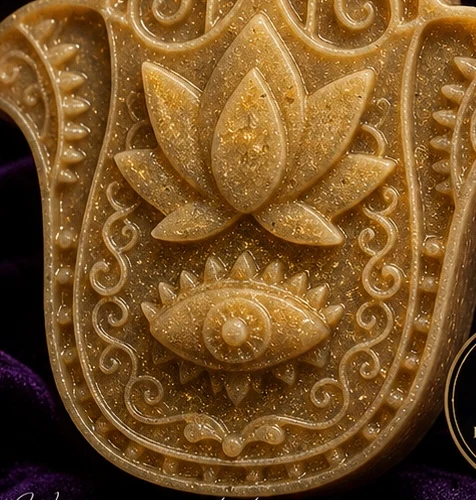
Close-up of the gold hand-shaped soap, with a raised lotus and eye

Gold Edition

Shea Butter Soap

A gold-toned, hand-shaped bar with a sculpted lotus and eye. A moment of intention in your daily cleansing ritual.

$10.00 each

Online checkout opens soon.

Explore the hand and lotus motifs

Symbols with distinct histories

Hand-shaped khamsa amulets have a history in North Africa and the Middle East, including Islamic and Jewish traditions. In ancient Egypt, the water lily often called the lotus represented daily renewal. These are distinct histories to explore alongside this contemporary design.

Museum examples: a Moroccan hand amulet, circa 1890s; and an Egyptian Lotus Flower Inlay, ca. 1347–1330 BCE.

Explore a hand amulet at the British Museum (new tab)Explore lotus symbolism at The Met (new tab)

Ritual soap

Drag the photo or choose a view to see a different angle.

$5.00 per two-bar pair · matching or mixed designs